Early life
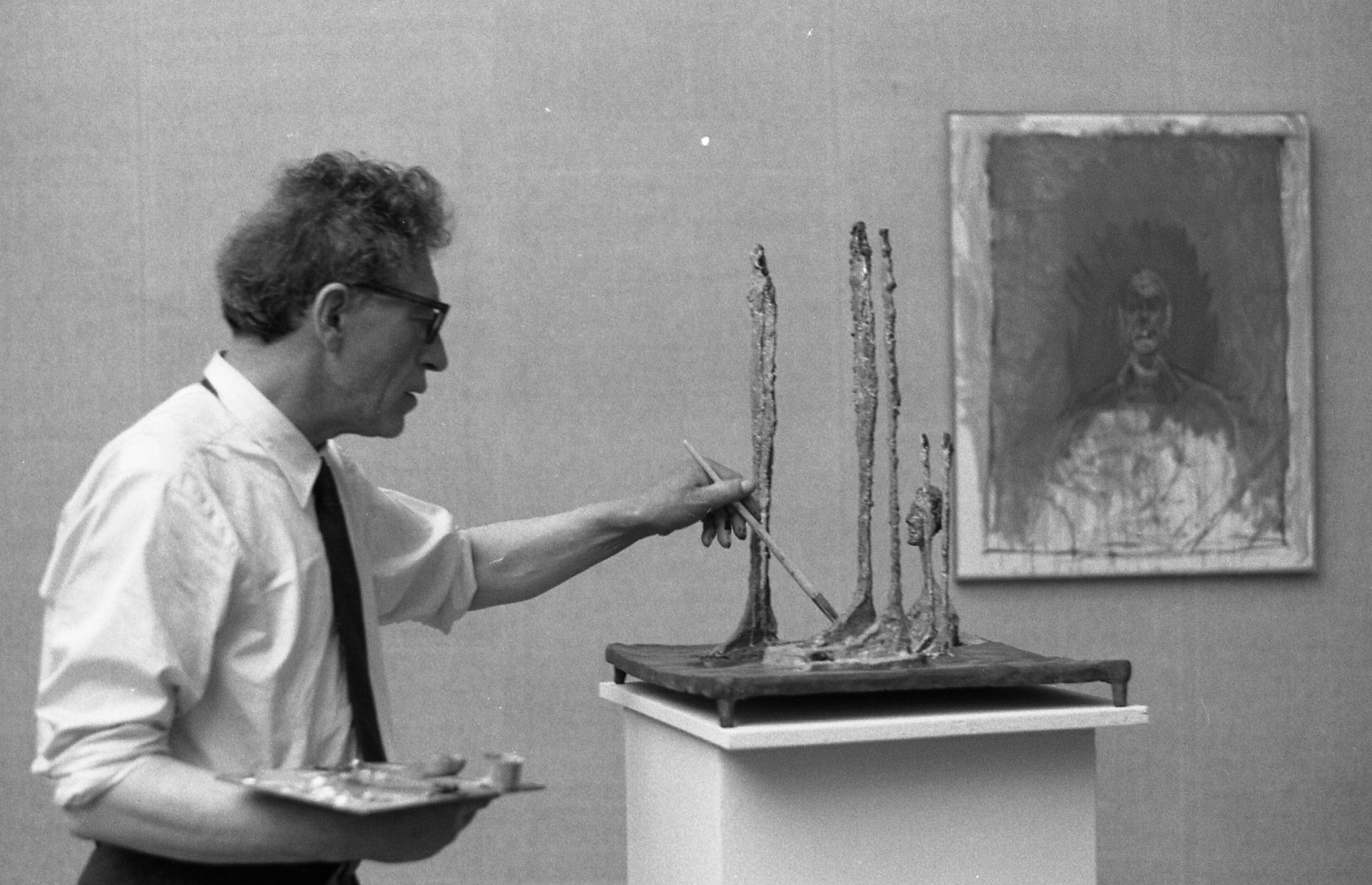
Alberto Giacometti at the 31° Venice Biennale in 1962, photographed by Paolo Monti (Fondo Paolo Monti, BEIC)
Giacometti was born in Borgonovo, Switzerland, the eldest of four children of Giovanni Giacometti, a well-known post-Impressionist painter, and Annetta Giacometti-Stampa. He was a descendant of Protestant refugees escaping the inquisition. Coming from an artistic background, he was interested in art from an early age. Alberto attended the Geneva School of Fine Arts. His brothers Diego (1902–1985) and Bruno (1907–2012) would go on to become artists and architects as well. Additionally, his cousin Zaccaria Giacometti, later professor of constitutional law and chancellor of the University of Zurich, grew up together with them, having been orphaned at the age of 12 in 1905.
The Life Of Giacometti
In 1922, he moved to Paris to study under the sculptor Antoine Bourdelle, an associate of Rodin. It was there that Giacometti experimented with Cubism and Surrealism and came to be regarded as one of the leading Surrealist sculptors. Among his associates were Miró, Max Ernst, Picasso, Bror Hjorth, and Balthus.
Between 1936 and 1940, Giacometti concentrated his sculpting on the human head, focusing on the sitter's gaze. He preferred models he was close to—his sister and the artist Isabel Rawsthorne (then known as Isabel Delmer). This was followed by a phase in which his statues of Isabel became stretched out; her limbs elongated. Obsessed with creating his sculptures exactly as he envisioned through his unique view of reality, he often carved until they were as thin as nails and reduced to the size of a pack of cigarettes, much to his consternation. A friend of his once said that if Giacometti decided to sculpt you, "he would make your head look like the blade of a knife".
During World War II, Giacometti took refuge in Switzerland. There, in 1946, he met Annette Arm, a secretary for the Red Cross. They married in 1949.
After his marriage his tiny sculptures became larger, but the larger they grew, the thinner they became. For the remainder of Giacometti's life, Annette was his main female model.[13] His paintings underwent a parallel procedure. The figures appear isolated and severely attenuated, as the result of continuous reworking.
He frequently revisited his subjects: one of his favourite models was his younger brother Diego.
LINKS: